
Tool Tipping Materials
Carbide & Other Tool Tipping Materials
From the book Building Superior Brazed Tools Buy the Book
Considerations in material selection
1. The big question: How much material can you cut for how little cost?
2. The longer you run between tool service the better.
3. Go for as much wear as you can get.
4. Settle for as much toughness as you absolutely have to have.
5. Welded materials are cheaper to install with expensive, automatic machines.
6. Harder materials run longer and have to be brazed.
7. Harder tungsten carbides and cermets cannot be brazed successfully without special processes.
8. The kind of material is maybe one-third of the success.
9. The people and the equipment are two-thirds of the success.
10. The right braze alloy allows you to move up to a higher grade without breakage.
11. No two tungsten carbide grades, hardfacing alloys or anything else are exactly alike.
12. The salesman is not really an expert in your operation. That is your job.
13. Test until you find what works for you then keep testing for what works better.
Historical progression - Historically the progression went somewhat as follows:
Steel
Tool Steel (High speed steel)
Cutting alloys - Co-Cr-W-Fe-Si-C (Haynes alloys, Stellite®, etc.
Tungsten Carbides
Cermets & Ceramics
Cubic Boron Nitride
Diamond
The major focus has always been machining steel. The desire has been to do as much work as fast as possible. As you work faster in machining you generate more heat. I attended a lecture where the following values were given. The point was to show how the development of newer materials effected machining operations. The example is based on a certain amount of work taking 100 minute using tool steel. The same amount of work can be done more rapidly using other materials. This example is certainly interesting but is very narrow and overlooks a huge range of variables. A big part of the difference was feed and speeds. A bigger part must have been changing the tools as they wore out from heat, wear, corrosion, etc.
Comparative times to cut steel including tool changes and tool servicing.
Cutting alloys: 50 minutes
Tungsten carbides: 15 minutes
Cermets & Ceramics: 5 minutes
Diamond: 1 minute
Run times - in typical wood sawing applications
Steel: 2 - 4 hours
Stellite®: 4 - 12 hours
Tungsten Carbide: 8 - 40 hours
Cermet: 8 - 120 hours
Knoop Hardness Ratings
Diamond: 6,000 - 6,500
Silicon Carbide (solid): 2,130 - 2,140
Aluminum oxide (corundum): 1,635 - 1,680
Tungsten carbide (Co binder): 1,000 - 1,500
Hardened Steel: 400 - 800
Steel
Steel is Iron with a very little bit of carbon in it. (Iron with .1 - .3% carbon with a maximum of 2.5%). Part of the difference between iron and steel is the iron tungsten carbides in steel.
Tool Steel
There are basically two kinds depending on how it is made. These are ingot cast and powder metal. Tool steels can be hardened to at least Rockwell C63 and will retain Rockwell C52 at 1,000 F. T-15 is generally considered to be best in the widest number of applications.
Seven major kinds of tool steel
High speed
Hot work
Cold work
Shock resisting
Mold steels
Special purpose
Water hardening
_tipped_saw.jpg "Stellite(R)_tipped_saw.jpg") |
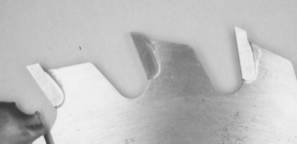 |
|
Stellite (R) Tipped Saw |
Carbide Tipped Saw |
Cutting Alloys (also hardfacing alloys)
Co-Cr-W-Fe-Si-C (Haynes alloys, Stellite®, etc.
These alloys are Cobalt, Chromium, Tungsten, Iron, Silicon and Carbon alloys. A Rockwell of C68, tensile above 100,000 lb/sq.in. Extremely acid resistant. They were widely used for cutting and machining tools but have been replaced by balanced high-speed steels and cermet type cutting tools. They are currently used in hard-facing and high heat corrosion applications. They have excellent high heat, wear and corrosion resistance. They are more impact resistant than many grades of tungsten carbide but not all.
Typical hardfacing alloy chemical composition
Co balance (app. 50 - 60%)
Ni 3% max
Si 2% max
Fe 3% max
Mn 2% max
Cr 28% - 32%
Mo 1.50% max
W 3.5% - 5.5%
C 0.9% - 1.4%
They are popular in automatic tool tipping applications. Generally the performance is not as good as the correct grade of tungsten carbide but they can be welded on and ground automatically more readily than shaped tungsten carbide. The labor savings are considered to offset the additional expense of the material and the reduced wear.
Hardfacing alloys such as Stellite® form carbides which give them a lot of their strength and wear resistance. These are Cobalt -Chromium alloys. When they are welded on the Chromium and Molybdenum combine chemically with the carbon to form Chromium carbide and Molybdenum carbide. This gives them good wear resistance.
Tungsten Carbide (Mostly tungsten carbides - also titanium, chromium, tantalum added)
These materials were developed in Germany and popularized during World War II because tungsten was scarce. You could machine more metal if you made tungsten carbide than if you used it for High speed steel. You can typically cut three to 10 times faster with tungsten carbide than you can with high-speed steel.
Tungsten carbide is actually grains of tungsten carbide in a matrix. Commonly this matrix is cobalt. This is pretty handy because you can mix carbon, tungsten and cobalt together and sinter them. The tungsten and the carbon form tungsten carbides and the cobalt does not. You get very hard grains for wear resistance and the cobalt stays relatively soft for impact resistance. These are sometimes called cemented materials and cemented tungsten carbide because the tungsten carbide grains are cemented together with cobalt or other materials such as nickel and nickel-chrome alloys.
Tungsten carbide is fairly yielding compared to the ceramics. You can take tungsten carbide, heat it and bend it into spirals and curves for cutters, which you cannot do with ceramics.
Cermets & Ceramics
These are either solid or cemented materials. Cermet technically means a metal-based ceramic. Now it most commonly means Titanium Carbonitride.
Ceramics
This usually includes cermets, which are metallic based ceramics. Cermets can be Aluminum Oxide, Silicon Nitride, Tungsten carbide and Titanium Carbonitride. If cermet is used alone it most likely (but not certainly) refers to Titanium Carbonitride. The story is given that this is because of a problem with translation from English to Japanese.
Ceramics as a class have low tensile strength and are relatively brittle. They are extremely strong under compression. Ceramics are extremely hard, very wear resistant, and typically have melting points well above the highest common metals. In addition they have excellent resistance to chemical corrosion. Organic solvents do not affect them.
Cermets
Titanium based cermets have high rigidity, compressive strength, hardness and abrasion resistance. They also have high strength at elevated temperatures and excellent resistance to chemical attack.
Cubic Boron Nitride
CBN can come close to equaling diamond in hardness with a rating of 5,000 kg./mm2 vs. diamond at 8,000 kg./mm2. It has an advantage over diamond in that it is more heat resistant.
Diamond
This is still the hardest substance known. It is available as PCD (polycrystalline diamond) which is lots of little diamonds in a matrix. This is a very good cutting tool tip material except that it is very heat sensitive. It is hard to braze because the common tool brazing alloys have a range of 1200 - 1350 F, which is the range at which the matrix breaks down. Diamond tipped tools are very expensive. They are generally regarded as being worth the additional expense if they do not break. They are very fragile compared to other tipping materials. Even though they may make sense economically the high initial investment required severely limits their use.